Set the size of a 3D object and prevent resizing in augmented reality
In short
Visuality displays your objects at the size defined in the 3D file, at 1:1 scale in augmented reality. The Object size in percentage by default field fixes a model that is too big or too small (from 1 to 500%), and a checkbox lets you stop customers from resizing the object.
Prerequisites
- A Visuality account with an active subscription or an ongoing free trial.
- A 3D object already imported into your library (GLB or USDZ file).
- The real dimensions of the product, to check the result with a tape measure.
Steps: adjust and lock the size
- In the 3D Object Library, open the object's menu (the three dots) and click Modify.
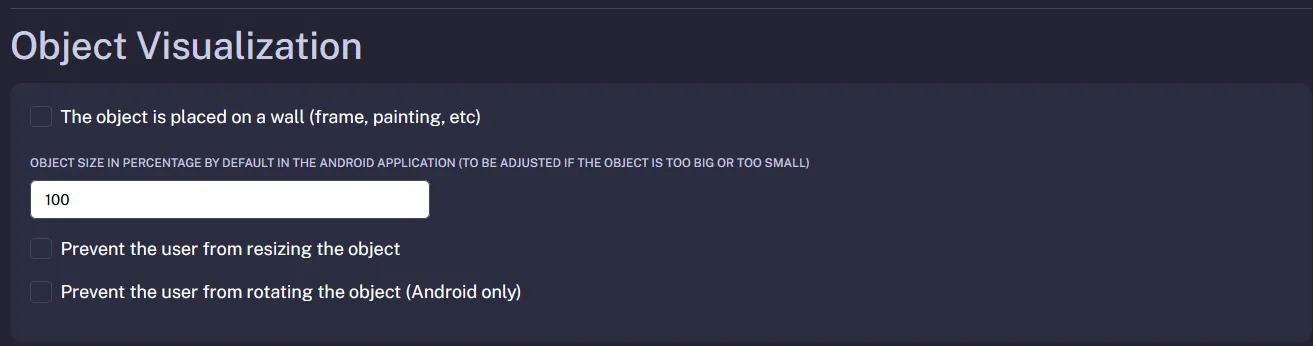
- Scroll down to the Object Visualization section.
- In Object size in percentage by default (to be adjusted if the object is too big or too small), enter a whole number: 100 keeps the file's size, 50 halves it, 200 doubles it.
- Tick Prevent the user from resizing the object so customers can no longer enlarge or shrink the object with two fingers in augmented reality.
- For a flat object such as a frame, you can also tick Prevent the user from rotating the object (Android only).
- Click Validate, then open the object in augmented reality and compare its size with a tape measure.
Good to know and limitations
- The percentage is applied uniformly (without distortion) to the 3D view and to augmented reality in the web viewer, including in groups of objects.
- On iPhone and iPad, AR Quick Look ignores the page settings, so Visuality bakes the size directly into the USDZ file, which is regenerated automatically after every change of percentage.
- On Android, if the phone opens the object in Google Scene Viewer rather than in the browser, the original GLB file is displayed without the percentage: the most reliable fix is still to export the model at the right dimensions.
- Resize locking works on iPhone, iPad and Android. In the 3D view, customers can still zoom in to see details without changing the object's real size.
- Rotation locking only applies to the Visuality Android app; in the web viewer, the object can still be rotated.
- If the object has annotations (hotspots), changing the percentage means you will have to reposition them in the editor.
Frequently asked questions
It is almost always a unit problem at export: the glTF format uses meters. A model designed in centimeters and exported without conversion looks 100 times too big; a percentage of 1 brings it back to its real size. The best fix is still to correct the scale in your 3D software.
Yes, in the 3D view: they can move the camera closer to examine details, but the object keeps its dimensions. In augmented reality, the object stays at the defined size and pinching no longer enlarges it, on iPhone and Android alike.
This option, marked "Android only" in the form, is applied by the Visuality Android app. On iPhone, iPad and in the web viewer, customers can still rotate the object.
Any questions? Feel free to contact us by email at contact@visuality.fr or by phone at 05 35 54 20 41!