Offer several colors or materials for a 3D product with variants
In short
Visuality automatically detects the material variants (glTF extension KHR_materials_variants) stored in your GLB file. You rename each variant in the object's settings, then your customers switch from one colorway to another from the viewer's Model menu, with no extra file.
In the example above, all the colors come from one and the same 3D file.
Prerequisites
- A Visuality account with an active subscription or an ongoing free trial.
- A model in which each color or material is a separate material, declared as a variant following the glTF "Materials variants" standard. Overview of the standard by the Khronos Group
- 3D software that can export these variants, for example: Blender, 3ds Max.
Steps: publish a product in several colorways
- In your 3D software, create one material per colorway, declare each variant, then export the model to GLB.
- Import the file into the 3D Object Library (or replace an existing object's file via Modify, in the File .GLB or .USDZ field), then click Validate.
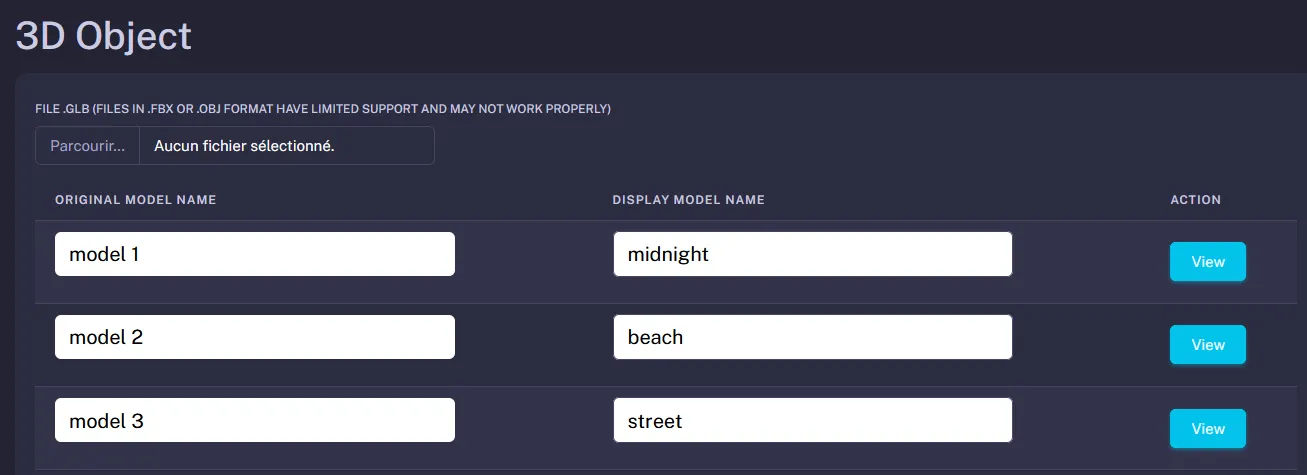
- Reopen the settings with Modify: a table of variants appears in the 3D Object section, with the Original Model Name and Display Model Name columns.
- Enter a customer-facing name in Display Model Name (for example "Light oak"); the View button applies the variant to the preview.
- Click Validate. In the viewer, your customers open Settings and pick a colorway in the Model section.
Good to know and limitations
- Variants can only be created in the 3D file: Visuality does not let you add a color or texture from the object's settings.
- Only a GLB file containing the KHR_materials_variants extension is read; an imported USDZ file does not bring any variants.
- Replacing the 3D file rebuilds the list of variants: custom names then have to be entered again.
- On Android, augmented reality opened in the browser (WebXR) keeps the selected variant; if the device switches to Google Scene Viewer, the object is shown with its default appearance.
- On iPhone and iPad, AR Quick Look shows the object with its default appearance, the one in the USDZ file generated by Visuality.
- Variants remain available when the object is part of a group.
Frequently asked questions
No. Variants are part of the GLB file: add the new material in your 3D software, declare it as a variant, re-export the GLB, then replace the file in the object's settings. Remember to rename the variants afterwards.
On Android, yes, when augmented reality opens in the browser. On iPhone and iPad, AR Quick Look shows the product's default appearance. To show a specific colorway on iPhone, you can import that colorway as a separate object.
Visuality does not set a maximum number of variants. Each texture does make the file heavier, though (150 MB maximum at import) and lengthens loading on mobile: use optimized textures.
Any questions? Feel free to contact us by email at contact@visuality.fr or by phone at 05 35 54 20 41!